‘Seeing and representing are “material,” insofar as they constitute means of intervening in the world. We do not simply “see” what is there before us. Rather, the specific ways in which we see (and represent) the world determine how we act upon that world and, in so doing, create what that world is. It is here, as well, that the social nature of vision comes into play, since both the seemingly individual act of seeing and the more obviously social act of representing occur in historically specific networks of social relations’ (Poole 1997, 7).
‘The visual field, which includes ways of seeing the landscape and the work of photographic production, in the context of a military occupation is a site of struggle over what remains, both in landscapes and imaginations of a possible, viable future’ (Hatoum 2017).
“Screening”1 is an action that transcends the limits of time and space, as Helga Tawil-Souri points to (2023, 233), and it is one that all of us in Occupational Formations working group have attempted to utilise at some point over the last year, in an effort to trace the (in)visible occupational formations of the Russian state in the temporarily occupied territories of Ukraine. Speaking personally, as a Ukrainian who migrated to the UK to study half a year before the beginning of the full-scale invasion, my screens, and the various assemblages that shape the materiality, significance, and meaning of what I consume through them (Tawil-Souri 2023), have become central to how I perceive the temporarily occupied territories, and Ukraine as a whole. This resulted in a “warring vision”2 (Phu 2021) that started taking hold and meddling with blurry and fragmented memories.
As I now scroll through the camera roll on my phone, screenshots upon screenshots of remediated images of ruination of all kinds, and the accompanying stories, donation visuals, obituaries, and text excerpts fill up the bites on my mobile device, half of which I did not recall ever making. Then there are those I consumed on a daily basis which evades a neat capture - footage taken from drones, video evidence of ‘reconstruction’ (read as erasure of war-crimes) in the temporarily occupied territories of Ukraine by Russian actors, the path of a drone hitting a building and the charred scar that it leaves behind. I dare not call any of these images and screenshots waste, they are the by-product of the “labour of witnessing” (Bazdyrieva & Matviyenko 2022), and yet I never seem to return to them, never give them the time and attention which I feel that each one of them needs.
These attempts at “diasporic witnessing”3 amount to an impossibility. This impossibility arises partially from the fact that the action of screening, and screens as material objects, are far from being neutral; they are murky, networked, and opaque (Tamil-Souri 2023), framing the ways of seeing landscapes and people at war and under occupational regimes through objectifying, algorithmically driven mass-media platforms, and the infrastructures of occupying states.4 Particularly when it comes to the temporarily occupied territories of Ukraine, witnessing even a fleeting moment of this “world-taken-from-us” - a world no longer fully available to representation (which Di Yehorova speaks to and dreams of with their interlocutors in their offerings to this project),5 is the other part of what makes this task so unfeasible. Upon each such attempt you only ever have fragments to pick at, and are left to work through the digital debris which is allowed through, escapes, or makes it out of the sieve (Helga Tawil-Souri 2023, 233).
In this offering of mine, I turn to question my relationship to such debris and its discontents, not to vilify visual material of destruction and ruination, as I know all too well how helpful it can be to rely on the evidentiary and affective force of such images,6 but to reflect on, more broadly, my own experience of continuously seeing what was once my homely landscape change through the screen, and more specifically, the experiences of my Ukrainian interlocutors with which I worked this past summer during my masters research on the ways of seeing home7 of Ukrainian communities in the East of Scotland. With this work, I ask whether it’s possible to change the ways in which we (the diasporic ((?)) and insider/outsider we) relate to such visual material, particularly if it “leaks out” (Yehorova, this project) of the temporarily occupied territories of Ukraine. I also wonder if there is a way in which we can see and represent the many cities, towns and villages currently under Russian occupation differently while not disregarding the violence of the Russian occupation in the process.8
These questions took shape through the time spent sitting with images my interlocutors and friends would bring during my fieldwork, seeing as many of the people I worked with ended up being from the temporarily occupied territories of Ukraine. They are, however, particularly indebted to our discussions with Kateryna Ustiuhova,9 an incredible writer, interlocutor and friend from Kreminna, Luhansk Region, Ukraine, a place which is currently under Russian occupation. One of the many photographs brought by Kateryna and related fieldnotes of mine will guide me through the following pages. I focus on this image in an attempt to trace a different way of relating and “listening to images” (Campt 2017) of the temporarily occupied territories, and attend to the “reverberations of violence” (Biner et al 2022) which the Russian occupation of Ukraine continuous to inflict as it ‘criss-crosses relations between the human body, the environment, materialities, space, and time’ (13) and is reconfigured onto the visual field through the mediation of the screen and the camera. Before I go any further, however, some further context is in order.
***
My fieldwork took place in St. Andrews and Dundee, Scotland, throughout May, June and July of this year, and consisted of multi-sited meetings with my interlocutors to which I asked them to bring photographs which relate to the notion of home. The choice of “desire-based” (Tuck, 2009) photo-elicitation as a method for this study was a deliberate one; it allowed for my interlocutors to shape the trajectory of this research and work only with those images which they would care to bring to the table.10 As became apparent, the more we worked with the visual material released into this study, there were three determining factors behind it being related to or signifying the homely.11 The first being the affectual connection of my interlocutors to the places the images make visible; the second, the materiality of the photograph; and lastly, the most important was the presence of my interlocutors at the poietic event, ‘when, allegedly, reality became an image’ (Canals 2022), either behind the camera or in its vicinity (Vazheyevskyy 2025).
In one of the first such meetings with Kateryna, an image of a struck apartment block, presumably her own, was brought up in an album entitled “War”. In the excerpt below, she explains why she chose to bring two different digital photo albums she kept on her phone to our meeting, and what each of them contained:
To the “ ”12 album, I saved photographs which I made before the (full-scale) war, four-five years ago, and I would call this home. This is home. And to the “War” album, I saved pictures which I got from different social media; from my parents when they still sent them. These photographs are of my native town and some kinds of ruinations. I know all of these places and see through the photos that now they are in ruin. But when I would be telling you about them, I wouldn’t say that that’s my home, I would say that in this album, “ ”, there’s my home, and the “War” one is more about what it (full-scale invasion) did to my home, but these photographs are no longer of my home. In them, there’s space which I personally haven’t been present in, they were sent to me after I have left, I wasn’t there when these photographs were taken.
Upon viewing these images and having this conversation, I became invested in understanding the mechanisms by which this unmaking of the homely takes place in the visual field, and the effects that this unmaking has on the notion of home in the imaginaries of my interlocutors, as well as my own. What was specific to the photographs brought by Kateryna in her digital photo-album entitled “War”, in contrast to the other photographs I have sat with, is that important too was the status of the photographed places themselves, on top of the other three criteria. Encountering the visuals of a home hit by a drone or damaged by a missile relegated the material place itself, along with any of its past visual representations, to the status of being unhomely. This may seem like a given, as a destroyed flat is not one where a person who was forced to leave their country due to the acceleration of the Russian occupation and wartime may live in. And yet, I want to give more time and attention in this text to tracing how exactly does said unmaking of the homely through the encounter with visuals of ruination mediated by screens operate as an extension of the Russian occupation.
I am to do so through a focus on a photograph of Schrödinger’s Flat, a found-image which Kateryna shared with me during my fieldwork. The image is anonymised throughout this text, not solely since we don’t know who took it, but also as a way of caring for the image and the affective connection many people might have to the places it makes (in)visible. This decision speaks to the anxiety with which many friends and interlocutors have spoken of and about the potential release into the digital publics of images which they have a personal connection to, particularly if said pictures are of (un)available places in the temporarily occupied territories which ‘have one’s heart’ (Vazheyevskyy 2025). Having been uprooted from their homes, ownership over these images and that which they contain has become incredibly important in maintaining and navigating desired imaginaries. Particularly at a time when Russia attempts to claim everything which remains under occupation as its own.
In such an environment, a different way of approaching and working with images is a necessity, which I attempt to test in this work with the aid of partial anonymisation. To borrow words from Arantxa Ortiz, the ‘anonymization of images can also be read as a muting that can facilitate audiences’ alternative engagements with political struggles, marking a departure from regimes of both looking and recognition that center visibility, transparency, and disclosure’ (2024). With this in mind, I now turn to the image of Schrödinger’s Flat, or potentially not, I cannot say for certain.
***
‘There are photos where I know for certain that it’s my apartment block, I know that for example that this balcony is our balcony. Yet there is a photograph in which I cannot tell, I’m uncertain, it’s not that even a lot of time has passed, but I understood that I can’t always evidence that it’s the block in which I lived all my life.
(…)
How am I to interpret, how am I to speak about this photograph, if at first it was the evidence for me that by my entranceway there are Russian soldiers walking, and now I look and wonder if it’s even mine, if it’s related to me in any way or its some random photograph. A very strange feeling, as if your memory lets you down.’
– Kateryna
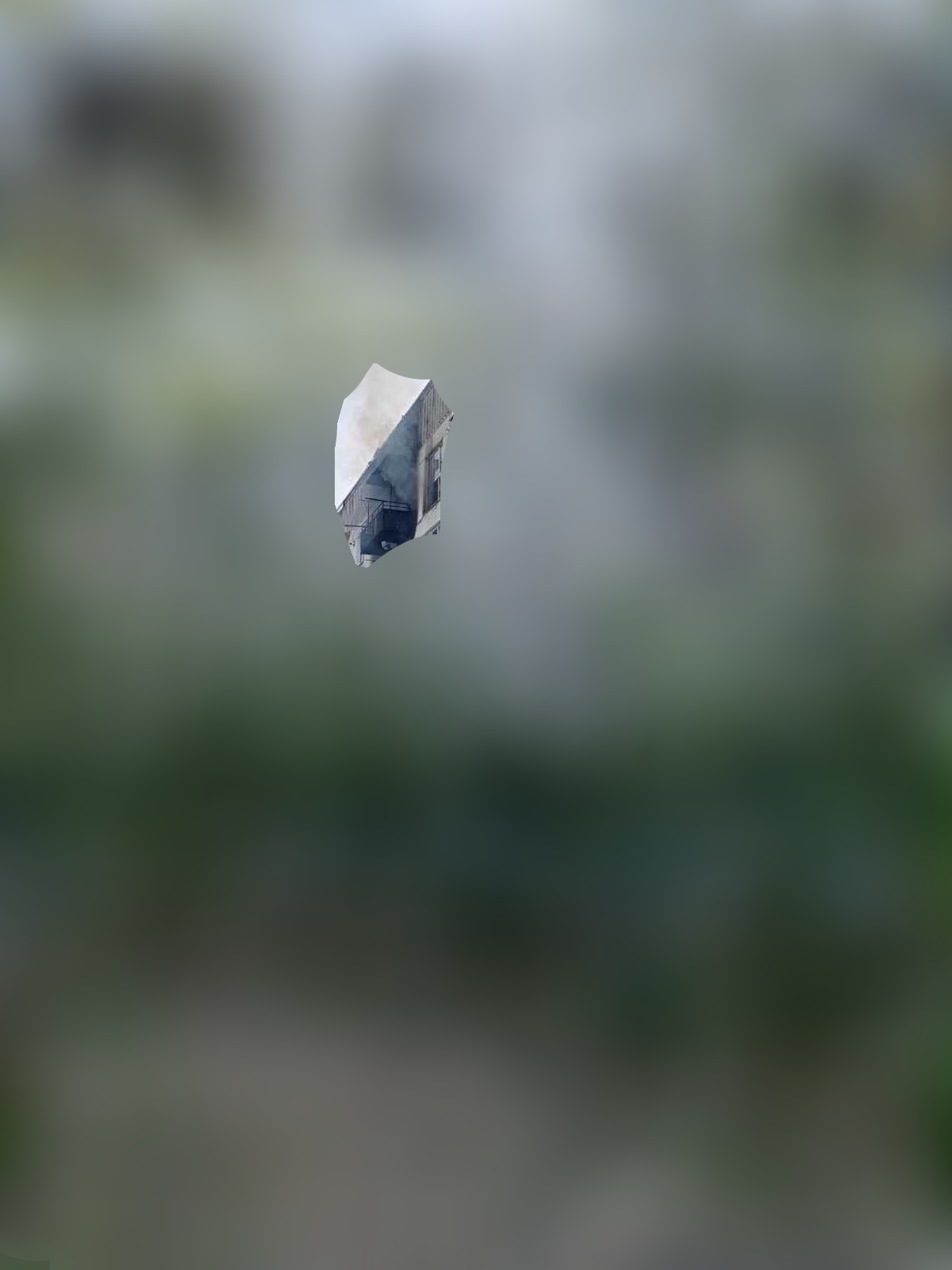
The balcony seen in this photograph, still fuming after being hit, was home to Kateryna and her family which they had to flee from upon the occupation of the town of Kremina by the Russian forces in 2022. That is, only potentially, as throughout our meetings, Kateryna could not say with certainty if this photograph was of her apartment block or not. This ambiguity, which arises from the inability to evidence from afar the status of one’s home in occupation worried Kateryna, it saddened her. After all, she communicated repeatedly how she always thought that home is something which must be recognised from any distance, from any angle, even while having one’s eyes closed. Yet reality proved to be far stranger than that; it is enough to change the angle, or to photograph the entranceway from above and not the side, and the certainty vanishes, the trust in the visual is gone.
This image was presumably the last trace of the place Kateryna and her brother referred to as Schrödinger’s flat, as due to the cementing of Russian occupational infrastructures in the region and the exhaustion caused by digging through local (Kreminna based) Telegram13 and Viber channels in search of the apartment, the family found no further visual material of it, or information about it since 2023. Neither were there any news coming from Kateryna’s neighbours, whom she relied on for some time upon fleeing the flat and moving to a safer part of the country with her family. The images which Kateryna received from her neighbours confirmed that a shockwave from a nearby blast blew out the windows in her flat, and that the buildings which were visible from her balcony were damaged. While technically showing homely places, neither the photograph found on Viber, pictured (anonymised) above, nor the images sent in by her neighbours made the cut into her album with the photographs of home ( ). Not only that, but when speaking about these images, she was hesitant to put trust in them, meticulously questioning their ontology.
Kateryna’s response to this image and others like it, which potentially make visible the ruination of her area, attests to the fact that placing trust in indexicality for evidencing is a dangerous game to play, particularly now, in the context of “diasporic witnessing” (Alyan 2024) of wartime in “the age of brutalism” (Mbembe 2025). The trust in the visual is simply not there anymore at a time when ‘clearing out’ territories and mass manufacturing of destitution by way of unhoming – deliberately targeting homes and shelters, making life unlivable for parts of the population deemed superfluous (ibid) – is broadcasted on social media and available to be consumed 24/7 through the screen. Particularly for those people who lack access to their homes, which remain in occupied territories, as is the case with Kateryna.
In this environment, it seems that the people forcefully displaced by the occupation attempt to find any information available on the status of their homes by way of digging through countless local Telegram and Viber channels, as well as networks of those who had stayed behind. The never-ending consumerism of ruined homes and buildings which this digging implies, alongside the rampant misinformation present in such digital publics, homogenises the spatial imaginary of the viewers, making it hard to tell flats apart through the screen among the debris and dissonant claims. In this case specifically, Kateryna also pointed out that all flats in her block seemed similar after the refurbishments of the building, adding to this mediated, murky vision. Add the ever-accelerating weaponisation and manipulation of images by state actors and (non)citizens to the equation, and it becomes clearer how the uncertainty in not being able to claim a photograph as evidence of the status of her flat takes hold.14
As the photograph of Schrödinger’s flat operates as an agent of ambiguity and uncertainty I describe above, it plays into the objectives of the Russian occupation that have to do with Ukrainian homes in the temporarily occupied territories of Ukraine, which, per Oleksiy Minko are ‘primarily aimed at reshaping the future by erasing the diversity of local pasts’ to fill the temporarily occupied territories with Russian ‘narratives, told “from scratch,” as if nothing existed before them’ (2025). The visual homogenisation of the landscape into an ambiguous terrain filled with war-related ruination, which cannot be differentiated by the local Ukrainian people, and the passing of time in displacement, without any news or updates about the status of one’s home, abets said erasure.
Based on this photograph’s capacity to aid in the rendering of Kateryna’s flat in Kremina as unhomely, a process that aligns with the settler-colonial goals of the Russian occupation described above, I argue that this image, along with others in its visual rhythm, contributes to emplacing “borders on the imagination” (Navaro-Yashin 2005) of Ukrainian subjects displaced from the temporarily occupied territories of Ukraine. Yael Navaro places this metaphor within the domain of the “psychic-political” (ibid), which speaks to the way in which through the ‘buzzing omnipresence as intervention in everyday life’ (Navaro-Yashin 2005, 119) political entities leave wounds in ‘the backroom of consciousness’ (ibid), and the ways in which they have been able ‘to constrain not only the lives, but also the consciousness and the imagination’ (Navaro-Yashin 2009, 114) of subjects.
While Yael Navaro conceptualised this domain and metaphor in relation to the physical containment of Turkish Cypriots in Northern Cyprus under the rule of the TMT (a right-wing Turkish Cypriot paramilitary organisation) and its offshoots, the current case differs in its mode of mediation. While no doubt a similar thing happens in the temporarily occupied territories, in this case, the consumption of images through the screens of smartphones, driven by their (re)mediation across the digital publics of Telegram, Viber, and Instagram, abets the facilitation of both the unhoming described above and the emplacing of “borders on the imagination” (ibid). These processes, in turn, play into the Russian occupation’s desire to erase the diversity of local Ukrainian pasts in the occupied regions.
Taking what I have written so far into account, however, I must agree with Deborah Poole that ‘it is almost too easy to consign all images to the task of reproducing (or perhaps even producing) imperial, racial, and sexual ideologies. The more challenging task is to think about the ways in which aesthetics and the “open code” of visual images occasionally disrupt the powerful hold that imperial discourse has over our imaginations’ (2021, 20). I now approach this task by looking at this image in a different light.
***
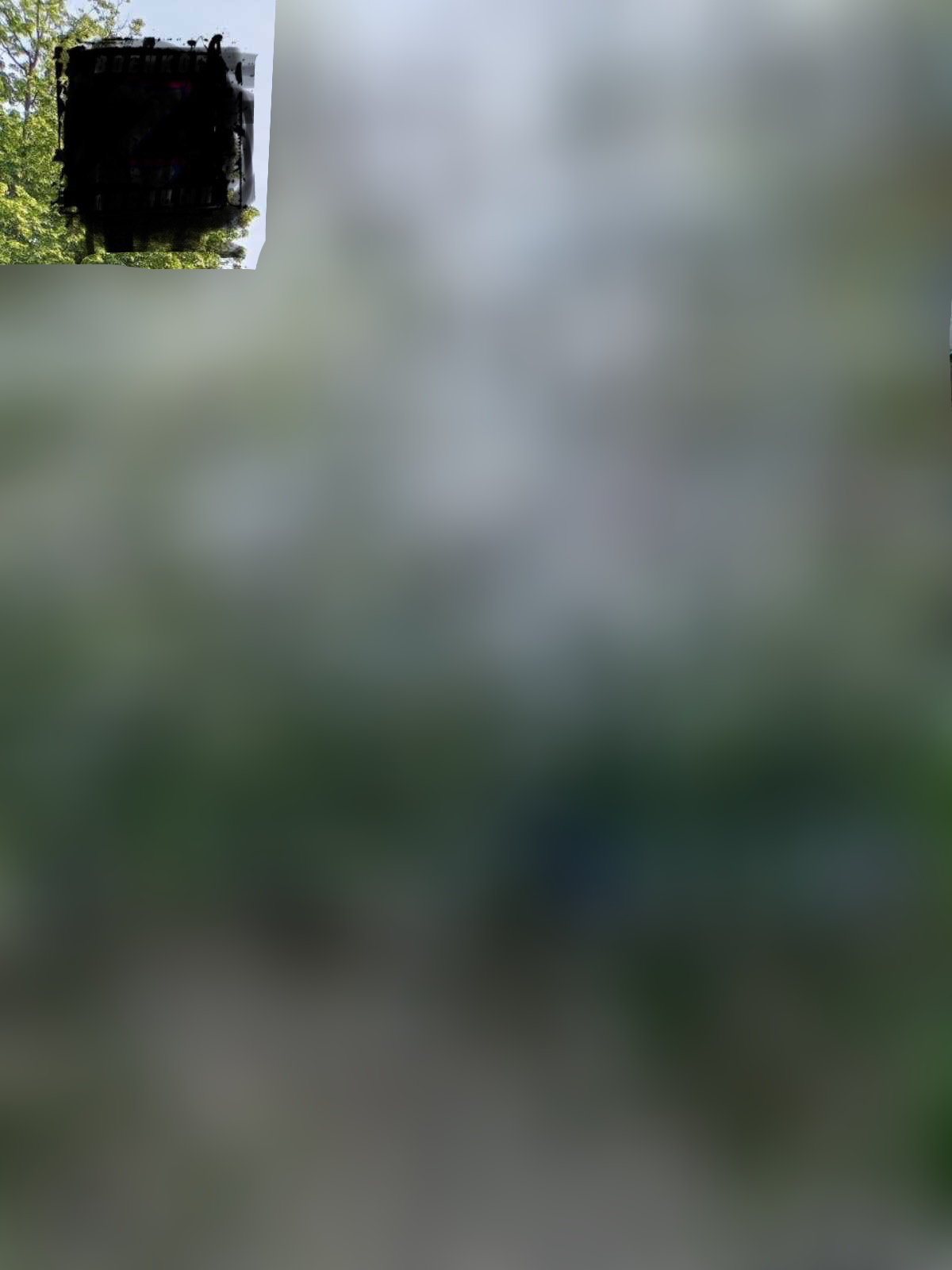
This is the same image of Schrodinger’s flat, yet anonymised by me in a different way to point to a subtle yet powerful form of refusal. What you do not see due to the black square drawn by Kateryna in the top left corner is a watermark of a pro-Russian Telegram and Viber channel, which was edited onto the image by pro-Russian actors to lay claim to it before its further dissemination on social media. This act of attempting to claim a photographic image of the temporarily occupied territories as one’s own, and by extension the place it makes visible, through the editing of pro-Russian watermarks, has been widespread since the beginning of the Russian war on Ukraine in 2014. It follows in the footsteps of the well-established imperial tradition of the usage of cameras, which was built on the right to take photographs in worlds that were “opened up” to people by imperial agents (Azoulay 2019, 226-227). And yet, in the current age of post-truth and incessant re-mediation, where it can be impossible to determine the originating source of an image upon an encounter with it, watermarks of pro-Russian digital publics operate as historically photographs did, laying claim to imperial ownership over the places made visible in the images.
Such a claim, however, while incredibly painful for many, is ultimately futile due to the unruly and unpredictable trajectory of images (Strassler 2020). As Kateryna’s intervention points to, politics as ‘image management has always entailed the risk of images spinning out of the control of their handles, refusing to conform to an expected path and prescribed meanings’ (ibid, 10). In scrutinising and reworking the image in this way, upon downloading it from a Viber channel, Kateryna has contested its ownership, resisting an easy consumption of the narrative attached to it by its pro-Russian mediators. While not having access to the physical place itself, through the interaction with this photograph in this way, she remains an agent in determining how the visual field of the temporarily occupied territories is seen and represented, even now, while living in Scotland. While this may seem at first as if it is too subtle of an act, too insignificant in light of all the horror brought on by the Russian occupation, I argue that it carries behind it so much more than what is seen at first glance.
This black square carries behind it decades of labour at local factories by Kateryna’s parents to afford the flat, and many more years to fashion and (re)fashion it to their liking. It speaks to the time, care and intimacy which Kateryna and her family have shared within its walls, and her ongoing resistance to the attempts by the actors of the Russian occupation to weaponise and operationalise her home. This act of refusal and negation holds within it dozens of images captured, and poems written by Kateryna, which point to a time before the occupation, and to the fact that this Ukrainian writer, daughter, mother, wife, and friend was there, present, in Kreminna before any Russian soldiers invaded these streets, claiming the land as their own while Russian state actors would cite bogus tales of historical ownership.
The fact of the matter remains, however, that confronting this image through her screen was one of the triggers which, alongside the current impossibility of a physical return due to the Russian occupation, influenced Kateryna’s thinking of her flat in Kreminna as being unhomely. My encounter with this image and Kateryna’s act of subtle refusal has only been possible due to the time we spent sitting together with her two digital albums and discussing every image which she cared to show. If this image were to be made public in this form, and I would see it through my screen on one of the many digital publics I frequent before our meeting, perhaps I would pay attention to this black square, or, perhaps, not knowing what to look for, I would simply scroll past.
***
Throughout my fieldwork, together with my interlocutors and friends, we sat with images of ‘beds, kitchen tables, mugs and food cooked by loved ones on familiar plates. A green and luscious garden, a favourite tree by the home of one’s parents, jars of fermented goods and herbs lying around the veranda. Images of mountains and the sea, distant lighthouses and dolphins peeking out of the water nearby one’s boat. Pictures of the places which have one’s heart deeply tied to the lives that my interlocutors lived back in Ukraine prior to their uprootedness’ (Vazheyevskyy 2025).
Through the many conversations we had around these images, a different way of seeing the temporarily occupied territories of Ukraine shone through, which stood in stark contrast to how the many occupied villages and cities are represented on mass-media platforms and digital publics. And even when the images we focused on contributed to the process of unhoming, which I discuss in my reflections on Kateryna’s response to the image of Schrödinger’s Flat, many other images and stories related to the places made visible in those images would surface in discussions. These, in turn, would ‘become a negative space to the images of destruction, acting as anchors essential for understanding what was destroyed’ (Osadcha 2025, 186), and would point to the continuity of Ukrainian past(s) in the temporarily occupied regions.
I want to try and interact ethnographically with those constellations of images and stories which reside in the negative space of the many visuals of the temporarily occupied territories which are being remediated. Those that point to a different sociality, a time before the occupation, filled with a vast array of local pasts which are in danger of erasure. Or the snapshots of the present, potentially filled with overlooked acts of refusal, all the while not looking away from the multitude of ruinations which the agents of the Russian occupation continue to enact. This task is not a negation of the horrors of the Russian occupation, which only continue to accelerate amidst the indifference and complicity of the international community (whatever that is at this point), and calls for Ukraine to accept neo-colonial treaties to cede land. It is not a way of romanticising the places and people which have been neglected, driven towards economic and social collapse, and made exponentially precarious by the Russian occupation.
Such attempts, which, as I see them, could involve a re-framing of the ways in which we see and represent the many villages, cities, landscapes and homes in the temporarily occupied territories can be valuable against the pull of the Russian occupation to erase and homogenise everything that points to a different sociality, and everyone who is a custodian of stories of the past, and visions of an alternative future. For as Kateryna told me during one of our meetings, ‘not solely war, not solely occupation, if we are to speak on the concept of home, then it shouldn’t be exclusively through the prism of war, as everything is through the prism of war now’. And while this may seem somewhat of an impossibility, I want to keep trying to see, imagine, and speak of the temporarily occupied territories in the way my friends and interlocutors do, no matter how hard it may be to do so.15
Abu Hatoum, N. 2017. Framing Visual Politics: Photography of the Wall in Palestine. Visual Anthropology Review 33, 18–27.
Alyan, H. 2024. ‘I am not there and I am not here’: a Palestinian American poet on bearing witness to atrocity. The Guardian, 28 January (available on-line: https://www.theguardian.com/world/2024/jan/28/gaza-palestine-grief-essay-poetry, accessed 30 November 2025).
Ayalogu, C. 2025. Diasporic Witnessing. Nordic Journal of African Studies 34, 18–37.
Azoulay, A. 2019. Potential history: unlearning imperialism. London ; Brooklyn, NY: Verso.
Bareikytė, M. & M. Makhortykh 2025. Digitally witnessable war from pereklychka to propaganda: Unfolding Telegram communication during Russia’s war in Ukraine. Media, War & Conflict 18, 348–365.
Campt, T. 2017. Listening to images. Durham London: Duke University Press.
Canals, R. 2022. Visual trust: Fake images in the Russia‐Ukraine war. Anthropology Today 38, 4–7.
Kulchynska, L. 2022. Violence is an Image: Weaponization of the Visuality During the War in Ukraine. Institute of Network Cultures (available on-line: https://networkcultures.org/tactical-media-room/2022/10/26/violence-is-an-image-weaponization-of-the-visuality-during-the-war-in-ukraine-2/, accessed 30 November 2025).
Matviyenko, S. 2024. Terror Environment. Essay presented at the, Mariupol Drama Theater Spatial Archive (available on-line: https://theater.spatialtech.info/en/essays/terror-environment, accessed 30 November 2025).
––––––– 2025. The Edge of Evidence: On the Labour of Witnessing, vol. 5. In Images and Objects of Russia’s War Against Ukraine (eds) M. Bareikytė, N. Klimenko & V. Sereda. (Forum Transregionale Studien - Dossiers). Forum Transregionale Studien e.V..
Mbembe, A. 2025. On Diminishment, I: Architecture and the Shelter-Rubble-Dust Continuum. e-flux Architecture (available on-line: https://www.e-flux.com/architecture/insurgent-geologies/667520/on-diminishment-i-architecture-and-the-shelter-rubble-dust-continuum, accessed 30 November 2025).
Navaro, Y., Z. Ö. Biner, A. V. Bieberstein & S. Altuğ 2022. Introduction: Reverberations of Violence Across Time and Space. In Reverberations (eds) Y. Navaro, Z. Ö. Biner, A. Von Bieberstein & S. Altuğ, 1–30. University of Pennsylvania Press (available on-line: https://www.degruyter.com/document/doi/10.9783/9780812298123-001/html, accessed 30 November 2025).
Navaro-Yashin, Y. 2009. Confinement and the Imagination: Sovereignty and Subjectivity in a Quasi-State. In Sovereign Bodies (eds) T. B. Hansen & F. Stepputat, 103–119. Princeton University Press (available on-line: https://www.degruyterbrill.com/document/doi/10.1515/9781400826698.103/html, accessed 30 November 2025).
Oleksii, M. 2025. The Temporal Occupation of Ukrainian Housing by Russia. AWCJOURNAL (available on-line: https://antiwarcoalition.art/texts/e5536be6-a8fd-4dc3-b960-6264bc2115b8, accessed 30 November 2025).
Ortiz, A. 2024. Caring for Images: Computational Anonymization as Refusal? Cultural Anthropology (available on-line: https://www.culanth.org/fieldsights/caring-for-images-computational-anonymization-and-feminist-sensory-ethnography, accessed 30 November 2025).
Osadcha, O. 2025. Regarding the Pain of One’s Own: Ukrainian Photographers In Times of War. In Researching and Curating Photography from Ukraine (ed) K. Filyuk. (First). 89books.
Panel Discussion: ‘The Labour of Witnessing’ 2022. presented at the Theater of Hopes and Expectations, 8 October (available on-line: https://www.youtube.com/watch?v=vdOX4pDLCic).
Phu, T. 2021. Warring visions: photography and Vietnam. Durham: Duke University Press.
Poole, D. 1997. Vision, race, and modernity: a visual economy of the Andean image world. (Princeton studies in culture/power/history). Princeton, N.J: Princeton University Press.
Strassler, K. 2019. Demanding Images: Democracy, Mediation, and the Image-Event in Indonesia. Duke University Press (available on-line: http://read.dukeupress.edu/books/book/2685/Demanding-ImagesDemocracy-Mediation-and-the, accessed 30 November 2025).
Tawil-Souri, H. 2023. Gaza Screened. In Gaza on Screen (ed) N. Yaqub, 231–237. Duke University Press (available on-line: https://read.dukeupress.edu/books/book/3224/chapter/7964478/Gaza-Screened, accessed 30 November 2025).
Tuck, E. 2009. Suspending Damage: A Letter to Communities. Harvard Educational Review 79, 409–428.
Vazheyevskyy, V. 2025. Photographs of Home and The Production of Unhomely Photographs. Unpublished masters thesis, University of St Andrews.
zlamavka 2025. 20 листопада 2025 Окупована Луганщина. Щоденники Мавок в окупації (available on-line: https://www.instagram.com/p/DRR2PiAjTgn/?igsh=ZjA3ZmVuNHVkdWE2, accessed 20 November 2025).
I use screening here as defined and conceptualised by Helga Tawil-Souri in her afterword to the edited volume Gaza on Screen (2023). The action of screening might mean ‘concealing, hiding, or shielding behind a partition (and that partition — the noun screen — is a necessary component of the action), whether for protection or otherwise (…) detecting, checking, examining, usually before a passage of some kind, and thus stalling, delaying, sometimes outright blocking’ (ibid, 232). ↩︎
In Warring Visions (2021), Thy Phu invokes warring as a gerund ‘to denote the active deployment of photographs for the ends of war and to suggest the labor and practice of war’. She goes on to show ways in which visual struggles are a central component of wars and their memories by looking at the counter-histories of the Vietnam War through the photographs of the Vietnamese communities in Vietnam and the diaspora. ↩︎
Referred to here as a practice which closely resembles Alyan’s (2024) description of witnessing the genocide in Gaza from abroad, and not Ayalogu’s formulation of diasporic witnessing (2025), even though much of it is also applicable. ↩︎
Here I’m particularly thinking with the following line from Svitlana Matviyenko’s Terror Environment - ‘The moment it feels like one is learning at least something from these screens about how Ukrainian people live there, behind the new Iron Curtain under the occupation… one should be reminded: this is Russian TV’ (2024). I too am thinking of the Zla Mavka diary entry from the 20th of November, 2025 which describes the ways in which Russian occupational authorities are forcing everyone to download a newly developed Russian messaging software - Max, by shutting down the possibility of the local population to use alternative softwares for communication. ↩︎
See Di Yehorova’s texts on this website. ↩︎
This is true for many cases, such as when it comes to fundraising to rebuild a home which was hit by a drone or a missile, or to make a case for future prosecution of the Russian state and its agents for war-crimes committed on Ukrainian land. Particularly when it comes to the temporarily occupied territories and the ongoing killing and sentencing of citizen-journalists, getting our hands on any visual material related to the occupation and the cementing of Russian infrastructures from Ukrainian sources comes with a great risk to the few admins of Telegram and Viber channels trying to disseminate and narrate it from the ground. ↩︎
Defined here as a geographically and affectually situated and imagined place, and not a common homogenous essence shared by a social group (Schiochett 2024 in Vazheyevskyy unpublished). ↩︎
This inquiry has been central for the many curators, artists, and activists from Donbas since the beginning of the Russian war on and occupation of Ukraine in 2014. I’m thinking here of the work of curators and writers Darya Tsymbalyuk, Vitalii Matukhno, Dmytro Chepurnyi, Milena Khomchenko and their colleagues who take part in organising the AfterDonbas conferences and other related events. The different people behind Izolyatsia who have been steadfast in working with cultural workers and stories from Eastern Ukraine against all odds. Organisations like TU Mariupol, which most recently have begun an incredibly important project re-imagining the many places, towns and cities destroyed by the Russian occupation (Not)Utopia. The many other writers, activists, journalists, photographers, artists, servicemen, women and non-binary people and everyone else who continue to re-imagine and fight for the memory and imaginaries of the temporarily occupied territories of Ukraine. This work is indebted to all of them. And while I mainly rely on literature from visual anthropologists and anthropologists of political violence in my writing, this text is in conversation with the urgent and embodied work being done by Ukrainian and Palestinian scholars of photography, images and representation of wartime. Particularly important to me is the recent work on the ethics of photographic practice in wartime by Oleksandra Osadcha (2025), Lesia Kulchynska’s work on the weaponisation of images in wartime (2022), Helga Tawil-Souri’s writing on screens (2023), and Svitlana Matviyenko’s and Asia Bazdyrieva’s conceptualisation of the “labour of witnessing” (2022), (2025). ↩︎
The choice to use Kateryna’s full name without anonymisation is one which we both agreed on, taking considerations of safety into account. Kateryna has written about many of the places and relevant themes written about here, you can follow her work on Kateryna Ustiuhova – Medium. ↩︎
As a researcher I also genuinely dislike interview-driven methods in social sciences for their likeness to practices carried out by agents of different border and carceral infrastructures. Pictures and camera rolls can too become a basis for interrogation however. ↩︎
I use this term to mean that which relates to the notion of home as defined in the 7th footnote. ↩︎
Name absent throughout the text for considerations of safety. ↩︎
For a more meticulous study of what they term “digitally witnessable war” through user communication practices in one such Telegram channel of a city currently under Russian occupation refer to the work of Bareikytė and Makhortykh (2024). ↩︎
The previous four paragraphs have been adapted from my MRes Dissertation The Photographs of Home and The Production of Unhomely Photographs (Vazheyevskyy 2025). ↩︎
Some questions remain around visual representation which I have no answer for in the present, however. If these constellations of images, which could work as counter-histories to the visuals proliferating on pro-Russian digital publics and mass-media platforms, cannot be made public due to questions of ownership I touched on in this text, how can we visually represent the places they make visible? I’m not sure anonymisation is the best way to go about it, even though it is something I test throughout this work, seeing as it could add to the murkiness and homogenisation of the landscape already produced by the mass (re)mediation of visuals of ruination. How can one go against both the regimes of looking and recognition, while at the same time not abetting in the visual murkiness which plays into Russian occupational rhetoric and goals? Do intimate and personal photographs of home have to be made publicly visible to refuse the visuality induced by occupational regimes? Can we not turn to language and poetics, as Di Yehorova does in their offerings? ↩︎